İzmir, Türkiye

replies within a day

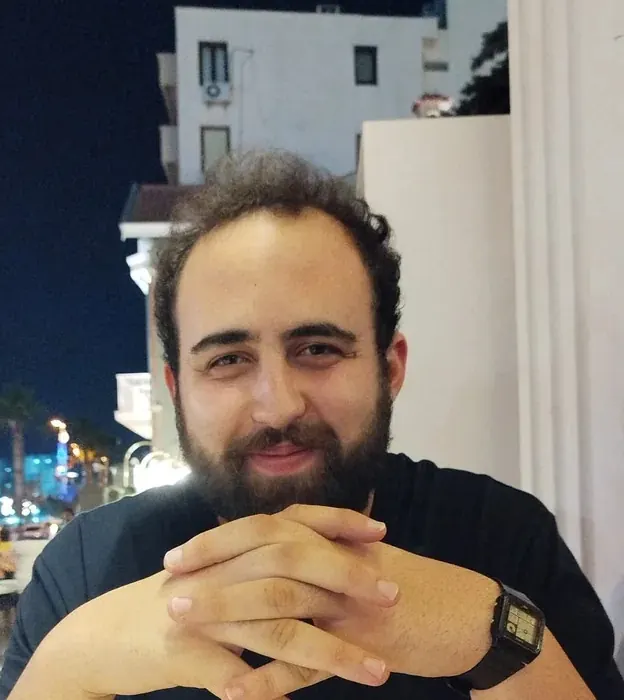
Muhammet Yağcıoğlu

I build solvers and the instruments that test them. I design and build websites too.

Final-year civil engineering student at İzmir Institute of Technology, minor in mathematics. TÜBİTAK 1001 scholar. Co-founder of MotoMap.

Muhammet Yağcıoğlu
01

Focus

What I work on

Mechanics

  • continuum mechanics
  • computational mechanics
  • finite strain solids and shells
  • hyperelasticity, plasticity
  • model verification

Fluids

  • Stokes flow, boundary elements
  • fluid-structure interaction
  • lattice Boltzmann
  • waves and coastal hydraulics

Signals

  • spectral estimation
  • system identification
  • Kalman, wavelet filtering
  • modal response
  • sensor calibration

Control and embedded

  • field oriented control
  • state observers
  • STM32, ESP32
  • CAN, RS485, LoRa
  • low power design

Computing

  • Python, JAX, Cython
  • C, C++, Fortran
  • Julia, MATLAB
  • automatic differentiation
  • profiling, fast kernels

Web design

  • interface and type design
  • React, Next.js, TypeScript
  • FastAPI, PostgreSQL
  • Docker, CI deploys
02

Mechanics

Solvers, and the audits that keep them honest

TÜBİTAK 1001224M2562025 to now

Magnetic shells in Stokes flow

A solver for thin hard-magnetic shells swimming in creeping flow. I wrote the shell, the boundary-element fluid and the magnetic coupling, solved together in one Newton step. My fast kernels took a time step from 1.84 s to 0.15 s without touching the equations.

PythonNumPyboundary elementsprofiling

82-page report2026

Auditing my own shell element

I stopped adding features and audited the rotation-free shell element. Seven defects, each fixed in closed form. The JAX rewrite takes force and tangent as exact derivatives of the energy, so Newton converges quadratically in about 200 lines instead of 1100.

JAXautomatic differentiationLaTeX

final year project69-page report

A finite strain element for Abaqus

An eight-node volume element written from the continuum mechanics up, as an Abaqus user element in Fortran. Hyperelastic material models, a consistent tangent, and large displacement tests checked field by field against the built-in element.

Abaqus UELFortranNeo-HookeanNewton-Raphson

sole authoron PyPI

femlab

A finite element toolbox carried across four languages. Ten shared benchmarks; eight match MATLAB to machine precision.

PythonMATLABScilabJulia

competition2026

DASK twin towers

A 1:50 balsa model of two towers joined by sky bridges. Modal, pushover and nonlinear time history analysis in OpenSees, with SAP2000 driven through its API. A damping sweep and a bootstrap fragility study bound the response.

Where the bridges go came from the literature. Patoliya, Patel and Agrawal (2023) compared linked towers of 20, 24 and 28 storeys and found three bridges, at a quarter, a half and three quarters of the height, to be the optimum, cutting displacement along the bridge by 30 to 35 percent. The competition also requires a bridge at the top, so the final model carries four, at floors 6, 12, 18 and 25.

OpenSeesSAP2000 Open APIPythonRust
Render of the balsa twin towersRender of a sky bridge truss between the towers
DASK 2026. Twenty-six floors, 153 cm, 1.386 kg against a 1.400 kg limit.
03

AI and signals

Machine learning where the data comes from a sensor

AI/ML engineer intern2026

HUBX

Speech models: text to speech and speech to text.

TTSSTT

TÜBİTAK 2209-A2026

Hayatın Ritmi

A wearable 12-lead ECG whose classifier runs on the microcontroller. 55 diagnostic classes, macro AUC 0.93 after 8-bit quantisation, 0.84 ms per inference.

PyTorchTensorFlow LiteSTM32BLE

AI leadTÜBİTAK 1812 BİGG

Mycellium-Aegis

Forest fire warning from buried mycelium biosensors. The alarm needs heat flux, drying rate and bioelectric spiking to rise together. A digital twin showed that moving the thermal probe up buys about 25 minutes.

signal processingfinite differencesSTM32L4LoRa

Teknofest2024 to 2025

İYTE Voltaris

Driver assistance for an electric race car: lane detection, traffic sign recognition and a classifier quantised for Hailo. Underneath, sensorless motor control and the STM32 boards that run it.

PyTorchHailoSimulinkCCAN

04

MotoMap

A router that knows it is on a motorcycle

We compute routes on our own graph. Every road is weighted for gradient, surface, curvature, lane filtering and live traffic. I own the cost model and the search kernels.

Engine
PythonCythoncontraction hierarchiesOpenStreetMap
Service
FastAPIPostgreSQLRedisDocker
Clients
Flutter appNext.js portalmotomap.co
MotoMap app, homeMotoMap app, route comparisonMotoMap app, navigationMotoMap app, garage
The app, in closed beta.
05

Web design

Designed and built, front to back

I design the pages myself and then I build them. I start in Figma, write the front end in React or in plain HTML and CSS, and build the API behind it in Python. I also set up the servers and the deploys, so I know the whole way from a sketch to a live site.

motomap.co, first screen
motomap.codesign and buildHTML, CSS, JStwo languages, no build step
motomap.co on a phone
The same page at 390 pxresponsive
motomap.co, the promise section
Type-led sectionsone ground colour, rhythm from media and width
motomap.co, how it works
How it worksfour steps, numbered by the grid
MotoMap API documentation
The API contractFastAPIOpenAPI 3.1clients generated from it
İYTE Voltaris team website
İYTE VoltarisReact Three FiberGSAPthe car turns in the browser source
İYTE Voltaris website on a phone
Voltaris at 390 pxresponsive
motomap.co, closed beta form
Closing screenfilm, one scrim, one form
Front end
ReactNext.jsTypeScriptTailwindThree.jsReact Three FiberFlutter
Back end
PythonFastAPIOpenAPIPostgreSQLRedispytest
Delivery
DockerCaddynginxGitHub Actions
Design
FigmaInkscapetype and colour systemsWCAG AA
06

Method

How I work

  1. Derive

    Kinematics and linearisation go on paper before any code.

  2. Verify

    Patch tests, manufactured solutions, convergence rates, then a reference solver.

  3. Measure

    Profile, change one thing, measure again, keep the numbers.

  4. Write

    A LaTeX report built from the same repository as the code.